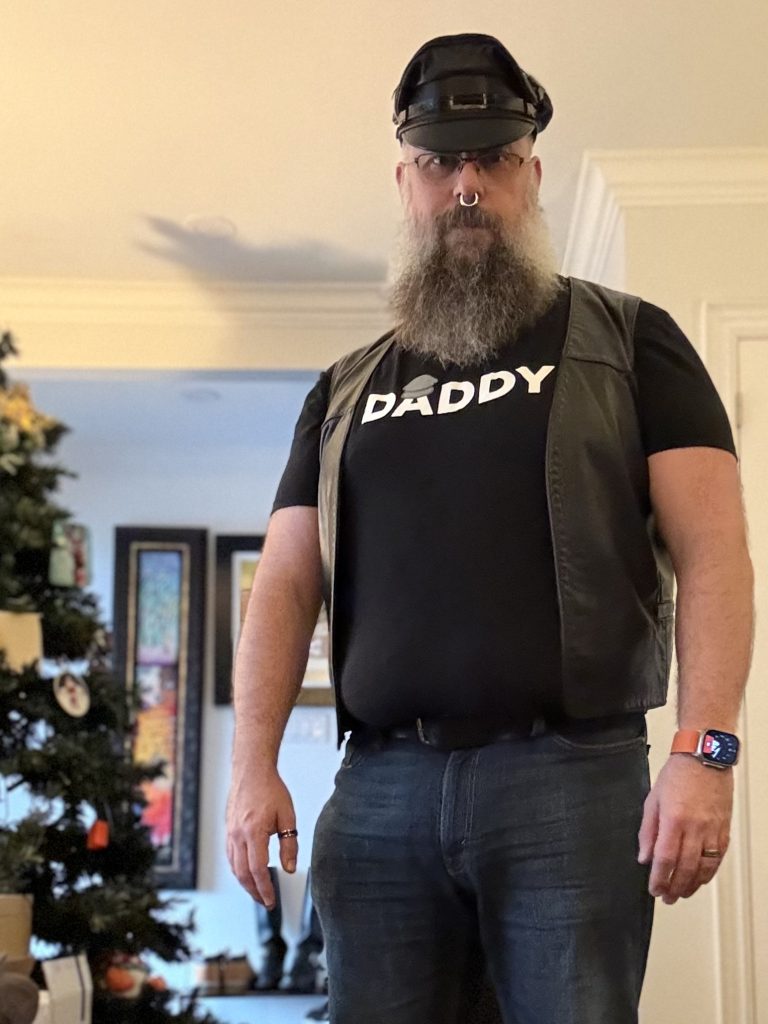
I decided to look at and clean up private and draft posts. The title of one of my draft posts caught my eye from 2013:
“Blah blah blah we’re a dying breed blah blah blah”
It was a good read, I’m not going to post it currently, howeverI think it’s still valid because I see this sentiment out there. I’ve had some good conversations with folks in different cities that I’m connected to, and my counter arguments still stand.
Some concerns are completely valid – for example, one conversation I had recently surrounds consent and how people are breaking people’s boundaries and that impact on desire for people to go out. I hope that’s limited to a few folks rather than a community standard because I know I won’t stand for my boundaries being broken and people need to learn what “no” means.
I digress, some I would say are completely invalid – Leather men are alive and well out there and I can cite good concrete examples.
During my visits to the UK and Europe, I’ve seen communities crumble and rebuild. Scotland comes to mind with Leatherman Scotland.
In the United States, I’m seeing people raise the necessary questions, what do we want to be? This is what I’m seeing, is anyone else seeing it?
Focusing more on Toronto, I’ve seen the fall of MLT and Heart of the Flag. I’ve seen BLUF grow over the past year, having started two years ago, and I’ve seen younger members – the next generation step up and build events with great energy that foster not just leather but a significant number of fetishes and identities.
I’m seeing necessary change, communities looking inward, some good thought and execution. Build it and they will come in many respects.
I propose, the folks who are saying “blah blah blah we’re a dying breed blah blah blah” are the ones who aren’t willing to change with the times, and that’s sad because they could easily be focusing their energies on staking their place.
When people talk about safety, I’m feeling that we usually think of it in very narrow terms, such as the following:
Physical harm,
Rules,
Boundaries,
What’s “allowed” and what’s not.
Those things matter, but they’re a baseline and somewhat obvious.
As I’ve been figuring out my path over the past few years and sort myself out, I’ve realized there’s a much deeper nuance we might be tippy toeing around. We know it’s there, we just don’t bring it to the forefront of thought.
I’d like to talk about safety in the context of belonging — I’m talking about something broader and quieter. Something most of us feel instinctively but rarely name.
Safety is what allows a person to stay.
Safety Is Not the Absence of Harm
Safety isn’t just the absence of violence or overt cruelty.
A room can be technically “safe” and still feel hostile.
A group can follow every rule and still make people shrink.
A space can say everyone is welcome and quietly punish those who test that claim.
Real safety isn’t about what doesn’t happen.
It’s about what does.
What People Are Scanning for When They Enter a Space
When someone walks into a room — especially someone who has been marginalized, traumatized, or repeatedly excluded — they are scanning constantly. I know I do, subconsciously, asking questions like:
Am I welcome here, or merely tolerated?
What happens if I say the wrong thing?
Will I be ignored, corrected, mocked, or dismissed?
Who seems relaxed, and who seems guarded?
Is attention given freely, or does it come with a cost?
What happens when someone is vulnerable?
Do people stay consistent, or do rules change depending on who you are?
This isn’t paranoia. It’s pattern recognition.
People learn very early what it costs them to be visible.
Safety Is Predictability
One of the most important and underrated components of safety is consistency.
People feel safer when:
responses are predictable
kindness isn’t revoked without explanation
boundaries are clear and stable
feedback doesn’t come wrapped in shame
affection doesn’t suddenly disappear
You don’t have to be perfect to be safe. but I propose you do have to be reliable.
Inconsistent warmth is one of the fastest ways to make a space feel unsafe.
Holding Space Is an Active Practice
We often talk about “holding space” as if it’s passive. It’s not.
Holding space means:
letting others take time without rushing them
allowing discomfort without trying to fix it
resisting the urge to center yourself
noticing who hasn’t spoken — and why
not punishing people for being careful
not demanding performance as proof of belonging
Holding space doesn’t mean lowering standards or abandoning boundaries.
It means enforcing them without humiliation.
Safety Is About Not Making People Earn Their Right to Be There
Many spaces claim to be inclusive but quietly expect newcomers to prove themselves.
To be confident enough. Interesting enough. Resilient enough. Easy enough.
That’s not safety — that’s audition culture.
Safety exists when people don’t have to minimize themselves, overperform, or apologize for taking up space just to remain welcome.
Why Safety Comes Before Belonging
Belonging is often framed as something people should choose. I have argued in previous posts that choosing belonging requires safety first.
Without safety:
the nervous system stays alert
risk feels dangerous instead of exciting
connection feels temporary
withdrawal feels like self-protection
People don’t fail to belong because they lack courage.
They struggle because safety hasn’t been established yet.
What It Looks Like to Create Safety
Creating safety doesn’t require special training or perfection. It looks like:
saying hello and meaning it
following through on what you offer
being clear instead of clever
naming mistakes without shaming
staying curious instead of defensive
noticing power dynamics instead of pretending they don’t exist
Most of all, it looks like showing up the same way tomorrow as you did today.
Consider that safety Is an Invitation to Stay
When safety is present, something subtle changes.
People breathe differently.
They stop scanning exits.
They take small risks.
They stay five minutes longer.
That’s how belonging begins.
Not with declarations.
Not with slogans.
But with consistency, care, and the quiet signal:
You’re okay here. You don’t have to disappear.
A Final Thought
If you run a group, host a space, lead a team, or simply care about community, here’s a question worth sitting with:
What does someone have to do in your space to remain welcome?
The answer will tell you more about safety than any mission statement ever could.
For most of my life, I’ve struggled with belonging. There are a number of reasons—some I’ve known for a long time, and some I’ve only recently understood.
I’m writing this as a celebration, as someone who cracked and continues to crack the code for themselves—someone who did their best, who learned how to stop a cycle of abuse, and who finally understands what safety and belonging actually mean. I’m also writing it for anyone walking a parallel path who might need a few pieces of language—or permission—to see themselves differently.
Content warning: This series includes discussion of childhood emotional abuse, neglect, and bullying.
Part 1 — Belonging Wasn’t Safe
School and the Illusion of Choice
From grades six to eight, I attended a private school with a house system not unlike what you see in Harry Potter. For the boys’ side, the houses were named after trees—Cedar, Birch, Maple, and Pine, if I’m remembering correctly.
One week during a house assembly, I was talking with a peer about not feeling like I belonged. I did my best to form friendships, but I felt like a fish out of water and the environment was very different from the previous five schools I had been to.
The teacher who ran the house overheard me and called me out publicly. What I remember isn’t his exact words, but the message was clear: You make your place. You choose to belong.
What I felt in that moment was shame. The feeling that I was wrong for feeling the way I did.
Looking back, he wasn’t entirely wrong—but he also missed something essential.
At the time, I was already feeling lost and since, as a result of living life, I’ve realized safety matters far more than people like to admit.
A Childhood in Motion
By the time I reached that school, it was already the sixth school I had attended.
Not because I was a problem, but because of circumstance.
While moving didn’t help—first from Newfoundland to Ontario, then within Ontario, it was the bouncing between public and Catholic systems. Schools changed because of geography, pressure from my grandmother, and adults making decisions that never quite accounted for what constant disruption does to a child.
In Grade 5 alone, I was split across two schools and three teachers. One teacher openly disliked me. Another announced on my first day, “You’re not in my classroom,” as though I’d personally offended her by showing up. It turned out she was friends with the first teacher.
That kind of reputation follows you. Especially when you’re a sensitive kid.
From a social development standpoint, there was never enough stability to put roots down. Just enough connection to feel it, and then—gone.
Bullying, Sensitivity, and Learning to Hide
I was a sensitive kid and that alone seemed to make me a target.
Bullying started early, around Grade 2. I don’t know exactly why—awkwardness, sensitivity, being different—but I learned quickly that being seen came with risk. Grades 3 and 4 were exceptions. I felt safer then, and I formed friendships that have lasted into adulthood.
Then everything shifted again.
In middle school, the private school environment was deeply sports-oriented, arts-oriented, competitive, and class-coded in a way I hadn’t experienced before.
From a sport perspective, I lived with lower back pain I thought was normal. Confidence, especially physical confidence, felt like something other people were born with.
I wasn’t visually artistic, but did have an interest in music.
In Grade 6 I was outed—well before I had admitted to myself that I was gay. While it mostly faded by Grades 7 and 8, I don’t think it disappeared from the room in the way people like to imagine. Once something like that happens, the sense of being on guard for the next hit doesn’t go away easily.
At the same time, my family life was becoming more unstable. By Grade 7, the weight of things outside school was impossible to ignore with a situation involving my sibling and her boyfriend. I spent part of Grade 8 in the hospital, right as rumours and false allegations of sexual abuse were circulating about my family.
Safety was becoming a foreign concept, especially for a young gay man navigating being a teen, the pressures of school and of an unstable home life.
Where I Actually Belonged
There were places where I felt safe: Music and computers.
Those spaces didn’t judge me, didn’t disappoint me and they rewarded curiosity, focus, and creativity. They didn’t require me to pretend, I could just be.
That’s where I found my place—not because I chose it bravely, but because it held me quietly.
So when I think back to the one teacher’s words—you choose to belong—I understand what he missed.
Belonging isn’t something you can choose when you don’t feel safe. Before you can belong, you need stability. You need protection. You need at least one place where you aren’t bracing yourself for impact.
What I Learned Instead
What I learned early was how to adapt. How to watch. How to stay small. How to become independent.
Those skills kept me alive. They helped me succeed. But they weren’t belonging.
I wasn’t failing to belong. I was surviving.
And survival, as it turns out, comes at a cost.
Part 2 — Family, Conditional Love, and Survival Mode
If school taught me that belonging was fragile, home taught me something even more destabilizing.
It taught me that love could be given and withdrawn. That safety was conditional and stability depended on other people’s moods, fears, and unspoken rules.
Because I didn’t just survive this environment—I eventually learned to see it clearly, and seeing it clearly changed everything.
Adoption and Early Division
I was placed with my parents when I was three and a half months old. My sibling had been born ten years into their marriage; I arrived years later, adopted after they decided to have a second child.
By 1979, my parents were separated. They divorced in 1981.
I didn’t fully understand the dynamics between my mother and father until 2018, when I cleared out the house I grew up in and read their divorce file. What I found was complicated mess, and it complicated what I thought I knew.
There were allegations and bitterness – not too uncommon for divorce. There were narratives that didn’t fully line up with lived experience, and there were definitely allegations of abuse in the file, and I can confirm that at the age of 3 or 4 I did receive a belting from my dad, an unproportional response to what was going on.
What became clear, was that my adoption had been used as a dividing line—one that placed me in a fragile position from the start.
According to the file, my father initially refused responsibility for me financially. Whether or not every detail was accurate, the message had consequences. That kind of early division plants uncertainty deep in a child. Unfortunately, it was weaponized by my mother and sister into the 90s and onwards, so I question was this true?
Regardless, later in my life, my father showed up. He supported me. He was curious about who I was. He helped fund my studies abroad. Life was not as simple as villain and victim.
What was consistent was confusion.
My Grandmother’s House
Much of my childhood was spent living with my grandparents. On paper, this provided stability. In reality, it came with unpredictability and fear.
My grandmother had a volatile temper. Her anger was sudden and disproportionate. When I was caught trying to take my beloved Merlin game to school for show-and-tell, she discovered it in my bag and hurled it across the house, smashing it.
Some might call that discipline.
I call it abuse.
No child deserves to be met with that level of rage. And no responsibility was ever taken for those moments—only shame handed down and absorbed.
Saturday arguments were a regular feature of life which often led to my mother being afraid to hold it together, where we would live, who owed whom, and what sacrifices were required. As a child, those fights translated into one question: Do we belong here? Do I belong here? And if so, for how long?
Becoming “The Man of the House”
Between the ages of thirteen and eighteen, I was effectively expected to be “the man of the house.”, and that grooming started early.
That phrase gets romanticized. In reality, it meant emotional responsibility without authority, and duty without support.
I was expected to hold things together while being given very little in return. When I needed support—real support—it often wasn’t there. When I was hospitalized in 1988 and needed my mother, she declined to come, citing work and cost, despite alternatives existing, such as my uncle, her brother, being able to help.
I was scared. I was a teenager and despite other family members telling me they could support, I felt alone and didn’t know how to engage and speak up. When I finally said I needed help to immediate family members – specifically my mother, they fell on deaf ears despite the support she had.
Conditional Love and Weaponized Guilt
Love in my family was complicated.
There was a strong matriarchal dynamic in which men were viewed with suspicion and resentment—except when we were useful. The messaging was contradictory: men were “scum,” but I was the “good one.” Men were to be used, manipulated, extracted from.
That kind of duality creates deep fractures in worthiness. You are wanted—but not for who you are.
I later watched guilt be weaponized. I was blamed for my grandfather’s death after he fell and broke his hip while “under my watch”—a fall that led to complications with anesthesia in hospital. That accusation followed me for years.
It doesn’t matter whether logic supports it. Trauma doesn’t operate on logic.
What it taught me was that love could be revoked instantly and it was. My mother and sibling kept me arms length unless they needed something. I never understood why, I was never told, so I was left asking and expecting support that never came.
Radical Independence as Survival
I learned not to ask.
I worked from the age of fourteen. I paid for my education, my rent, my living expenses my self with no expectations of support from my immediate family. I figured things out because there was no reliable place to land.
Even when I struggled financially or medically, reaching out didn’t feel safe. My broader family stepped up.
Independence became my armor.
It looked admirable from the outside. From the inside, it was exhausting.
Why Family Felt Like a Fallacy
When I went to university, interest in my life faded almost entirely from my mother and sibling. I had to insist on visits. I had to insist they attend my graduation. I had to fight to be seen.
I remember telling my mother about my first pay raise after I started my career. Her response was, “You should be giving some of that to me.”
That moment crystallized something I couldn’t yet articulate: my value was measured by what I could provide.
Family, as a concept, was hollow and a fallacy. I was truly on my own.
When I encountered functional families—friends’ families, my cousins, eventually my husband’s family—the dissonance was stark. I didn’t believe I was worthy of that kind of care. Even when it was offered, I struggled to accept it.
That belief followed me for decades.
Survival Mode Has a Long Half-Life
Everything I did made sense. The walls. The independence.
The difficulty accepting love. The push-pull dynamics. The fear of being pushed out.
These weren’t personality flaws. They were adaptations.
And they worked—until they didn’t.
Part 3 — Cracking the Code
If the first part of my life taught me how to survive, this part taught me something radically different: how to stay.
What I eventually learned—slowly, imperfectly, and with help—is that belonging was never missing. It was waiting for safety.
When All the Old Fears Collided
There wasn’t one breakthrough moment. No single realization that suddenly fixed everything, but there was a period of time when everything I feared converged at once—and I couldn’t avoid it anymore.
A 17-year relationship was ending. At the same time, another close relationship I deeply valued felt suddenly unstable as my partner was navigating the end of his marriage and the beginning of another relationship. I found myself in a place I knew far too well: not feeling safe, not feeling secure, and bracing for abandonment from multiple directions at once.
It was terrifying to describe the feeling at the time.
That fear didn’t come from the present moment alone. It tapped directly into old wiring—the belief that love disappears without warning, that stability is temporary, and that I would be left alone once again in the crossfire of other people’s choices.
For the first time, I couldn’t explain it away or push through it with independence. My old strategies stopped working.
Naming the Fear for What It Was
What I was facing wasn’t just grief, jealousy or insecurity.
It was fear of abandonment.
Fear that I had never learned to soothe because for so long it wasn’t irrational—it had been reinforced. When love had been conditional. When care had been withdrawn. When being “strong” meant being left to handle things alone.
That fear showed up in every part of my body – hypervigilance, anxiety – the urge to pull away before I could be pushed out.
This is where therapy stopped being optional and became essential.
Not to stop the fear—but to understand it.
What Changed Wasn’t the Situation — It Was the Response
The relationships didn’t resolve overnight. What changed was me.
For the first time, I didn’t treat my fear as something shameful or something to outrun. I stayed with it. I named it. I let people see it—carefully, selectively, but honestly.
Something unexpected happened – I wasn’t abandoned. People stayed.
Not perfectly and not without discomfort, but consistently enough that my nervous system could finally register something new: I don’t have to disappear to survive this.
That realization didn’t “fix” me but it gave me a foothold.
From Crisis to Practice
That period cracked something open.
It forced me to confront the belief that had shaped most of my life: that connection is always temporary and that I am ultimately on my own.
Healing didn’t come from the crisis itself. It came from what followed—learning how to tolerate closeness without panic, uncertainty without self-erasure, and love without bracing for collapse.
That’s when belonging stopped being theoretical. That’s when practice began.
It Took a Village
Support changed my life—real, consistent support—from people who had the capacity to see me clearly and stay.
My aunt, uncle, and cousins;
My husband’s mother – my mother-in-law,
My husband,
My partners,
My therapist
These were people who didn’t just offer reassurance. They offered steadiness. They showed up again and again. They didn’t punish me for hesitation or guardedness. They didn’t withdraw when things got uncomfortable.
They stood by me modelling something entirely new: love without a trapdoor.
I didn’t trust it at first. I couldn’t. My system didn’t know how.
They didn’t rush me. They stood by me.
Learning to Accept Love as Real
For a long time, love felt theoretical.
I could recognize affection intellectually, but I couldn’t feel it land. My instinct was always to scan for the withdrawal, the cost, the moment where the rules would change.
Therapy helped. Not because it erased the past, but because it gave me language for the patterns I was living inside of.
One concept that stuck with me was the idea of a mirror.
Some people hold small mirrors—they can only see part of you, often the part that confirms their worldview. Others hold larger mirrors. They have the emotional capacity to see more of you, even the complicated parts.
Understanding that distinction was freeing.
It helped me stop chasing recognition from people who couldn’t offer it—and helped me invest in relationships where I was actually being seen.
The Practice of Worthiness
Healing didn’t happen because I suddenly believed I was worthy.
It happened because I asked quieter questions:
What if the people who love me are telling the truth?
What if I don’t need to earn my place?
What if I was worthy of connection and didn’t need to sell myself short?
What if the version of me I learned to hate was built in self-defense?
What if I am a beautiful person and not the monster I thought I was?
What if I was not the ugly person I thought I was?
What if I don’t need to disappear to stay safe?
What if people were right that I am worthy and chose to listen to that, to try it on
Trying those questions on was deeply uncomfortable.
Old beliefs pushed back hard. The nervous system doesn’t give up survival strategies easily, so I didn’t force it. I practiced. I practiced staying and just being with it. I practiced letting care in without immediately deflecting it. I practiced noticing consistency instead of testing it.
Over time, the negative voices softened. Anxiety stopped running the show. The constant self-monitoring eased.
Not because I became fearless—but because I became safer. I trusted myself.
Belonging as a Practice
Here’s the part that changed everything for me:
Belonging isn’t something you find. It’s something you practice until the room notices.
Not by demanding space, not by performing, not by proving but by arriving less guarded. By staying present. By taking up space without apology. By trusting that you don’t have to disappear to be loved.
Once safety exists, belonging can grow. Once belonging is practiced, it starts to reflect back—not as permission, but as recognition.
Where I Am Now
I still have moments of doubt and I still have old reflexes. Healing isn’t linear, but I see and feel continued progressive healing and every time I notice it, it’s a huge win.
The difference is profound. I no longer live in survival mode. I no longer confuse independence with isolation. I no longer chase love where it can’t exist.
If you will, the blackout curtain burned down. What remains is light—sometimes steady, sometimes flickering, but real.
For the first time in my life, I know this: I belong here. Not because I earned it, not because I proved anything, but because I stayed.
Series Note
If you’ve seen yourself somewhere in this series, I hope you know this:
Nothing was “wrong” with you. You adapted. And adaptation is not a failure.
A year ago, I took on building connections. I’ve known for years where I’m best able to build connections, so I specifically sought out non-bar spaces and events.
That’s when I learned about the Bears/Pups swim that takes place on Mondays at the Wellesley Community Centre. As a result,
I’ve met a bunch of non-judgemental people that are open and welcoming, and that’s been fostered by a small community,
I used to go into the Black Eagle and my social anxiety would immediately go into overdrive and I’d become a wall flower. I now know people who will likely be at the Eagle as a result of the cross-community nature of that swim,
I’m also connected to people online and have a source list of events and such so I know what’s going on in the city be it more social or bar-based and people who are attending.
This week has been the first Leather Week that has taken place in several years in Toronto. I’m not exactly sure who specifically arranged it, but I’ve heard that BLUF Toronto was involved. To whoever was involved, thank you for your work to set this up. For the events I was able to attend, it was amazing.
When I heard about it, I became excited. I knew I wanted to be present and add positive energy to the community. I knew that I wanted, for me, to connect with others, to really change my view on going out in Toronto, and to finally lay claim to whatever my spot is.
I know when I attended my first BLUF event in Toronto about two years ago, I did not go into it with the right attitude. I didn’t say it was bad, but it did feel like a bunch of cliques in gear that weren’t open. I also recognize that you generate what you make of it, and I call myself out on that. I know I went into it that event with anxiety and with certain expectations that didn’t need to be there.
Talking to the Bootblack for the night that was staying with us, it seemed a bit of both. People were commenting about some of the anxiety they were feeling about connecting with others, so I guess it’s the combination of what we all bring to the space, our abilities to be social.
The energy last night was bonkers amazing. It felt connected, relaxed, and alive in a way I’m not sure I’ve felt in Toronto in a long time. I know part of that came from a real shift in how I approach this city—but I also know I wasn’t the only one feeling it.
When people let their light shine, great things happen. For me, that doesn’t mean being louder or more outgoing. It means paying attention to the energy I bring into a space—my expectations, my mood, the stories I tell myself before I walk through the door.
It means arriving with the belief that I belong there. That I’m worthy of connection. That I don’t need permission to take up space.
No one had to create that space for me – it was already there. I claimed it by showing up less guarded, more open, and willing to connect. And when a few people do that at the same time, something shifts. People begin to hold space for each other—often without even realizing it.
That’s the energy I felt last night. And it felt really, really good.
Maybe belonging isn’t something we find—it’s something we practice until the room notices. Not by forcing connection, but by showing up consistently and honestly, without armor. By acting as though we belong before there’s any guarantee that we do.
Over time, something shifts. The room begins to respond—not because it was convinced, but because it recognizes something familiar – comfort, ease, presence. Belonging doesn’t arrive as permission; it arrives as recognition.
For me, that practice has meant resisting the urge to shrink, to brace, or to disappear the moment I feel unsure.
It’s meant returning again and again with a little more openness each time, until being there starts to feel natural. Until the room no longer feels like something I’m trying to enter, but something I’m already inside of.
When that happens, space doesn’t need to be made—it already exists. And we step into it together.